
On 25 July 2026, Union Education Minister Dharmendra Pradhan resigned following weeks of NEET-related protests. For supporters of the Cockroach Janta Party (CJP), it was a turning point. The satirical Instagram identity that had developed into a protest movement was suddenly central to a national news story. The Indian Express reported the resignation and CJP’s account of talks with the Centre.
The argument about CJP has often been political. But there is another way of studying it: as a story about the economics of attention. Who followed it, what people searched, how short videos travelled, which creators became part of the news, and how quickly misinformation followed?
The data supports one conclusion: creators and short-form videos were integral to CJP’s visibility. It does not prove that they alone organised every demonstration or caused the minister’s resignation. That distinction runs through the numbers below.
25 million followers, and nearly 90% aged 18–34
CJP’s Instagram account is reported at 25 million followers, with a 1.41% overall engagement rate, as per Qoruz. On May 20, TCI reported more than 3 million followers at that earlier point; that is a historical snapshot, not today’s count.
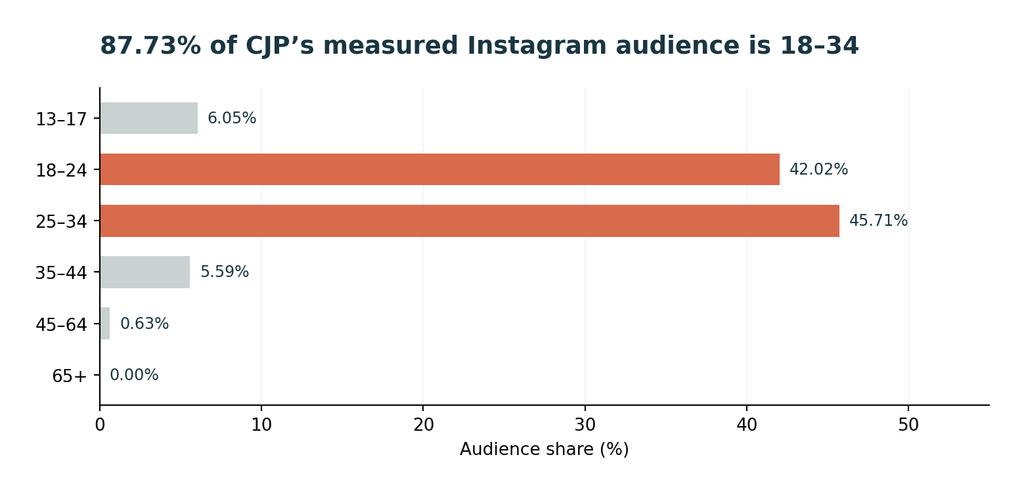
More revealing than the headline follower number is the audience mix. Qoruz’s audience-age breakdown shows 42.02% aged 18–24 and 45.71% aged 25–34. Combined, that is almost 90% aged 18–34. The largest individual bracket is 25–34, so describing the account simply as a teenage audience would misread the data.
Source: Qoruz audience screenshots
The same audience snapshot reports 76.66% male and 23.34% female, with an audience credibility score of 91.18%. The credibility figure is the analytics provider’s own classification, not proof that 91.18% of accounts are genuine individuals or that followers agree with CJP.
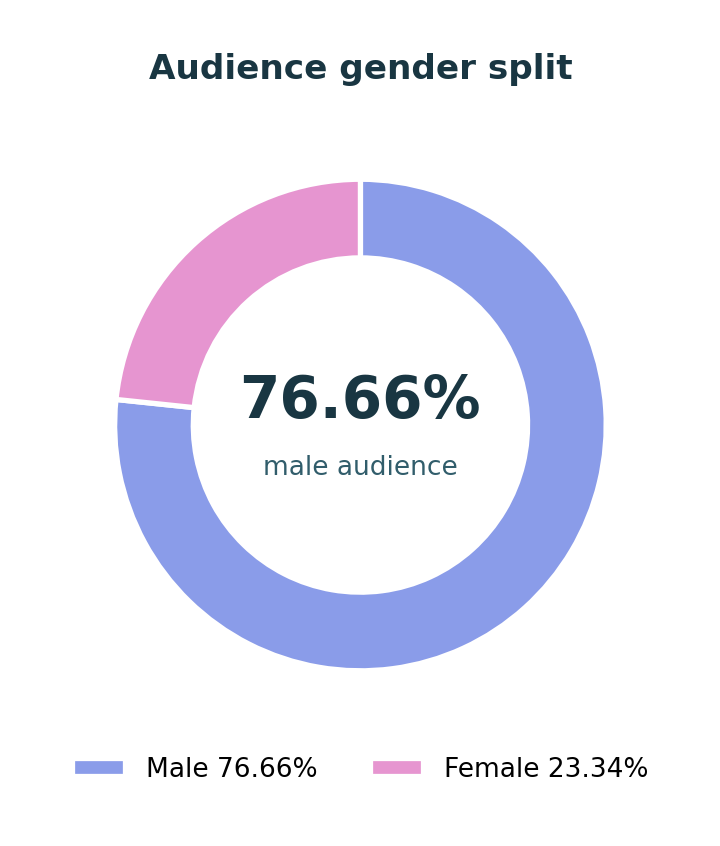
Source: Qoruz screenshots
More Read



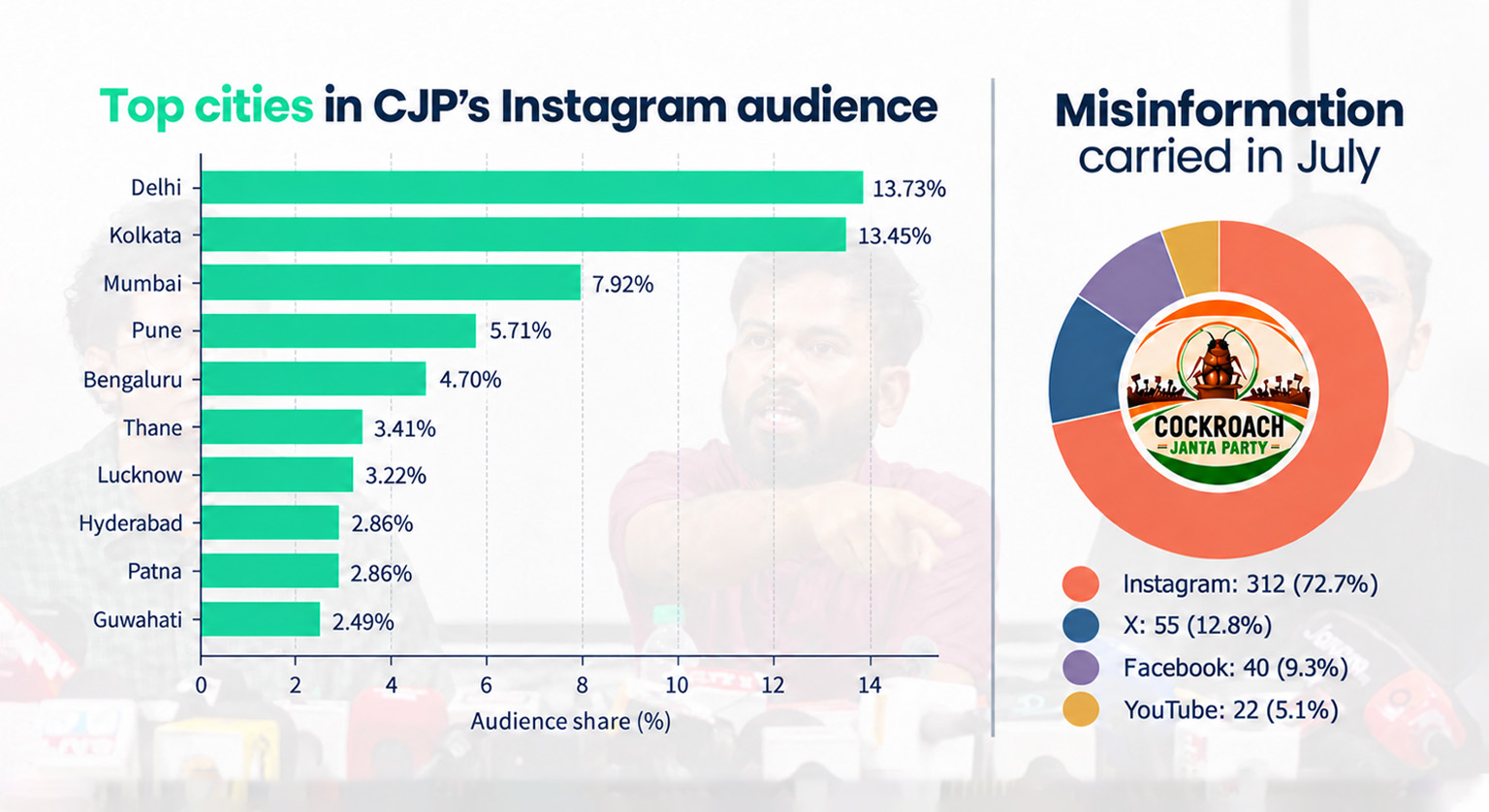
Its measured audience is also spread across several large Indian cities. Delhi represents 13.73% of the listed audience, Kolkata 13.45% and Mumbai 7.92%. Pune and Bengaluru follow. These city percentages describe the Instagram audience, not the number of people who attended protests.
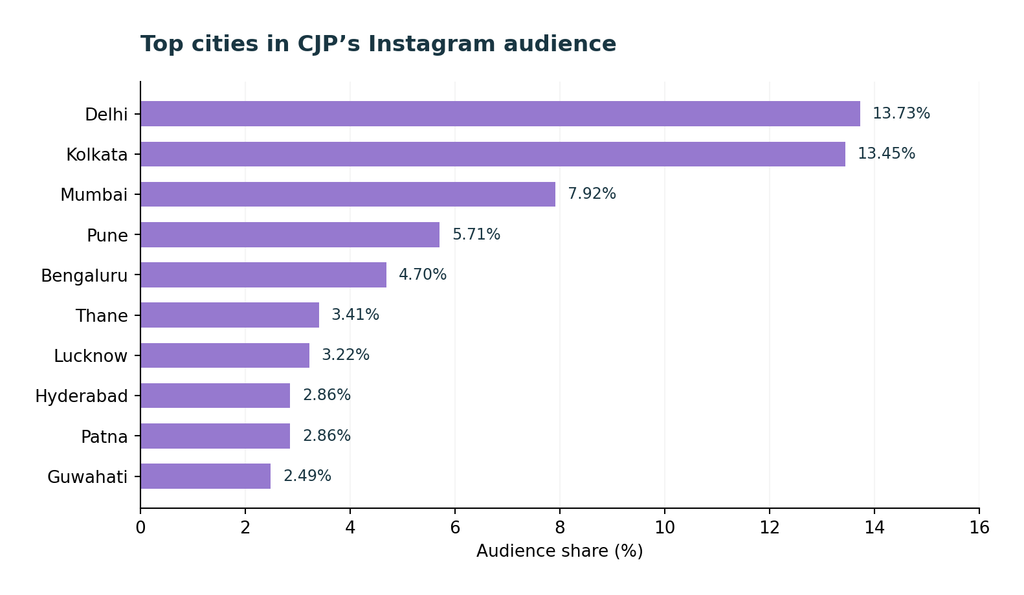
Source: Qoruz
From May to October, CJP produced two distinct waves of Google search interest
A July-only chart captures the dramatic protest peak but misses the earlier moment when people first discovered the party’s name. Ahrefs’ historical keyword estimates allow both phases to be viewed together: the May breakout for the Cockroach Janata Party, followed by the July peak for CJP protest.
Across May to October 2026, Ahrefs’ modelled monthly figures for just two exact search phrases sum to approximately 62.71 lakh: 48.61 lakh for Cockroach Janata Party and 14.10 lakh for CJP protest. These are sums of Ahrefs’ historical monthly estimates. They are not verified Google search totals or unique searchers; people may search multiple phrases, and October is incomplete. They must not be presented as a census of everyone who searched CJP.
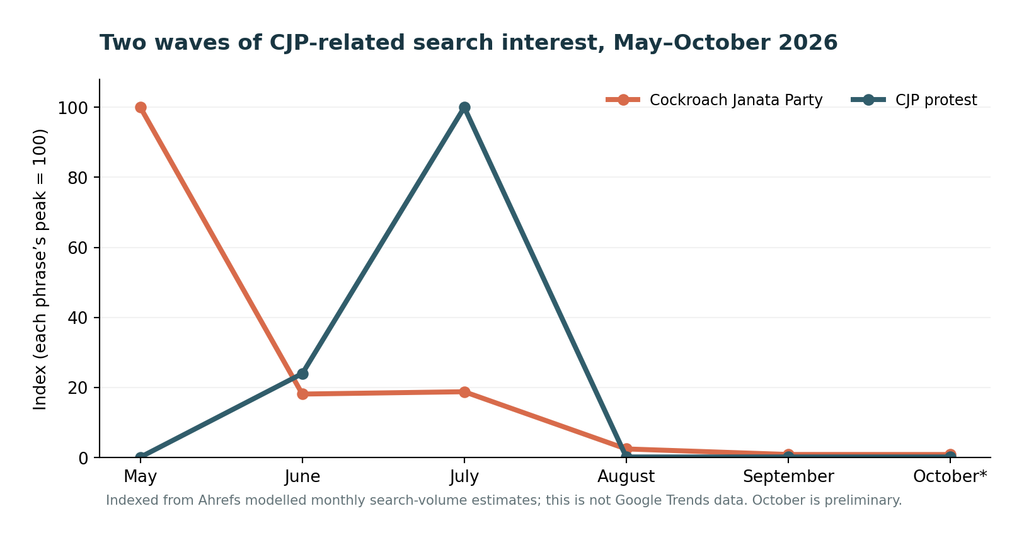
Source: Ahrefs-derived comparison, not official Google Trends data
| Month in 2026 | Cockroach Janata Party: estimate | CJP protest: estimate |
|---|---|---|
| May | 34,51,406 | 598 |
| June | 6,24,025 | 2,71,419 |
| July | 6,47,040 | 11,33,852 |
| August | 82,891 | 1,255 |
| September | 28,151 | 1,255 |
| October* | 27,683 | 1,255 |
Source: Ahrefs Keywords Explorer
| Tracked phrase | Sum of May–October estimates |
|---|---|
| Cockroach Janata Party | 48,61,196 |
| CJP protest | 14,09,634 |
| Two-phrase combined estimate | 62,70,830 |
Calculation: sums of the six Ahrefs monthly estimates for the two specified search phrases.
What changed most was the type of search. In May the movement’s name was the story. By July audiences were searching for Delhi demonstrations, petitions, live coverage and named organisers. That is consistent with a brand-like protest identity becoming a practical way to find real-world news. It is not proof that an individual Reel made anyone attend.
What were Indians searching for in July?
CJP protest reached an estimated 11,33,852 monthly searches; CJP protest in Delhi reached 3,68,942; and Cockroach Janata Party petition an estimated 3,56,632. Searches for Abhijeet Dipke, Saurav Das and the Education Minister’s resignation show that people were also seeking personalities and outcomes, not just the movement’s name.
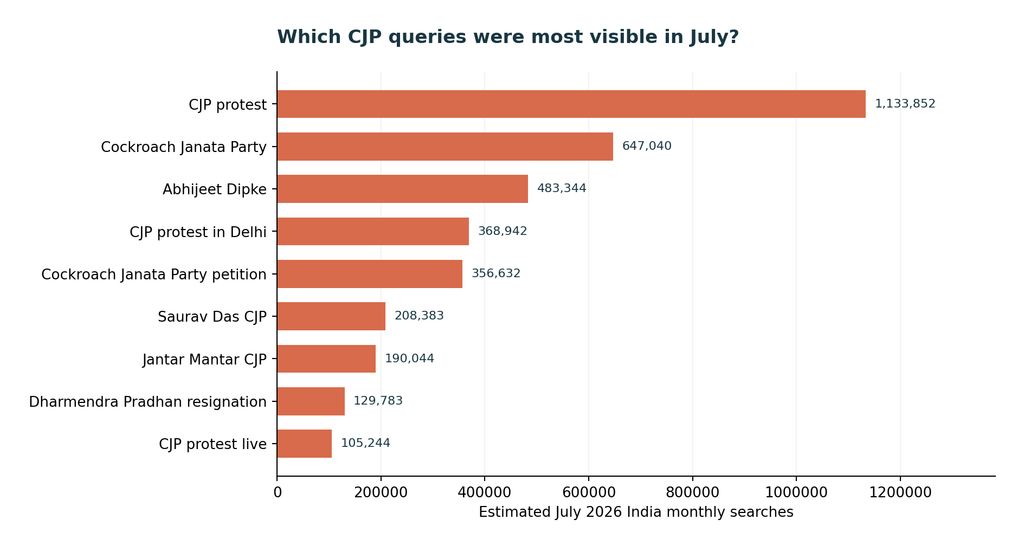
Source: Ahrefs India historical estimates; individual queries overlap.
| Search query | Estimated July India volume | Search intent |
|---|---|---|
| CJP protest | 11,33,852 | Protest |
| Cockroach Janata Party | 6,47,040 | Movement identity |
| Abhijeet Dipke | 4,83,344 | Organiser |
| CJP protest in Delhi | 3,68,942 | Location |
| Cockroach Janata Party petition | 3,56,632 | Petition |
| Saurav Das CJP | 2,08,383 | Spokesperson |
| Jantar Mantar CJP | 1,90,044 | Location |
| Dharmendra Pradhan resignation | 1,29,783 | Issue |
| CJP protest live | 1,05,244 | Live coverage |
| CJP protest latest news | 28,399 | News |
Source: Ahrefs Keywords Explorer, India
The questions people typed were equally revealing. They asked what CJP was, whether it was still protesting, who funded it and whether it was registered as a political party. Questions about funding or legitimacy are measures of curiosity, not findings that the allegations implicit in those questions are true.
| Actual search question | Estimated July India volume |
|---|---|
| What is Cockroach Janata Party? | 35,127 |
| Is CJP protest still going on? | 15,891 |
| CJP kya hai? | 11,923 |
| Who is Abhijeet Dipke? | 8,300 |
| Is CJP a real political party? | 7,264 |
| Why is CJP protesting? | 6,800 |
| Who is funding CJP? | 2,626 |
| Has CJP protest ended? | 2,474 |
| What are the demands of CJP? | 2,374 |
| Are farmers joining CJP protest? | 1,761 |
Source: Ahrefs Keywords Explorer, India
The movement travelled from an Instagram joke to the street
CJP began in May as a satirical online project; TCI documented its early reach. It then moved through Delhi gatherings and a July escalation, with the resignation of the Education Minister on 25 July marking the clearest political turning point in the first protest phase. The Indian Express traced key moments of that sequence.
| Date | Turning point | Why it matters to the digital story |
|---|---|---|
| 16 May | CJP launches online | A meme-friendly identity is designed for digital circulation |
| 20 May | 3M+ followers reported by TCI | Early breakout scale, an historical snapshot |
| 6 June | Delhi gathering | Digital identity becomes an on-ground protest |
| 20 July | March towards Parliament | Street scenes become live and short-form news content |
| 25 July | Education Minister resigns | The first protest cycle reaches a political turning point |
| October | Election Commission / SIR phase | The same CJP identity returns in a different public dispute |
Sources: TCI; The Indian Express
This progression is what makes the movement unusual as a creator-economy story. The visuals were recognisable without an elaborate explanation: a cockroach motif, rapid jokes, protest signs, direct-to-camera reactions and clips from the street. Unlike a conventional press briefing, that material could be remixed by people who had never attended the demonstration.
Creators became participants, commentators, critics and subjects of the story
A curated archive of protest coverage identified 63 videos from 13 YouTube channels across its selected period. That is a sample of recorded coverage, not a total count of CJP videos or views. Still, it shows the diversity of formats: on-ground reports, interviews, reaction clips and extended explainers.
The TCI reporting brief identifies names across different roles in the July and October cycles. Some amplified demonstrations, some criticised organisers, and others became separate news subjects. Their individual incidents should be linked to independent coverage before those claims are published as fact.
| Phase | Creators and voices identified for source checking |
|---|---|
| July: coverage and participation | Abhinav Bisht,, Shradha Singh, Jaanmoni Das, Rhiya Ahir, PeekTV, Kunal Kamra |
| July: critics and counter-voices | Swatantra Bhardwaj, Abhishek Thakur, TG Mohandas, Faizan Ansari, The Pamphlet (Deepak Sharma), Sunaina Holey, Ketan Anoop, Rishi Bagree |
| October: later phase | Dhruv Rathee |
The movement also entered conventional news coverage. NDTV’s 22 July interview questioned CJP spokespeople Ashutosh Ranka and Saurav Das about the NEET agitation, police action and politics. NDTV also carried a later briefing. That shows a digital-born protest making people visible to television audiences. It would go too far to say the broadcaster was forced to put them on air.
Prime Minister Narendra Modi’s short, front-camera-style 23 July video offers another telling detail: even the official response appeared in a format familiar to audiences of creator videos. The connection is about communication style, not evidence that CJP dictated the government’s messaging. It belongs in the narrative, rather than as a competing headline visual.
The same news cycle carried misinformation through July and October
The movement’s online reach also made it possible to circulate altered or misleading material at speed. Newschecker examined AI-altered videos that falsely appeared to show BJP leaders threatening protesters. AFP Fact Check examined a fabricated document, while a separate Newschecker analysis showed how a cropped clip changed the meaning of a scene. These are distinct fact-checks, not proof that a particular proportion of CJP content was false.
In July, Maharashtra Cyber said it had identified 429 objectionable handles or posts in a flagged set associated with protest-related misinformation, including 140 described as AI-generated or AI-assisted. As reported by The Times of India, the platform counts were 312 Instagram, 55 X, 40 Facebook and 22 YouTube. This is a July-specific sample, not a total for the movement since May.
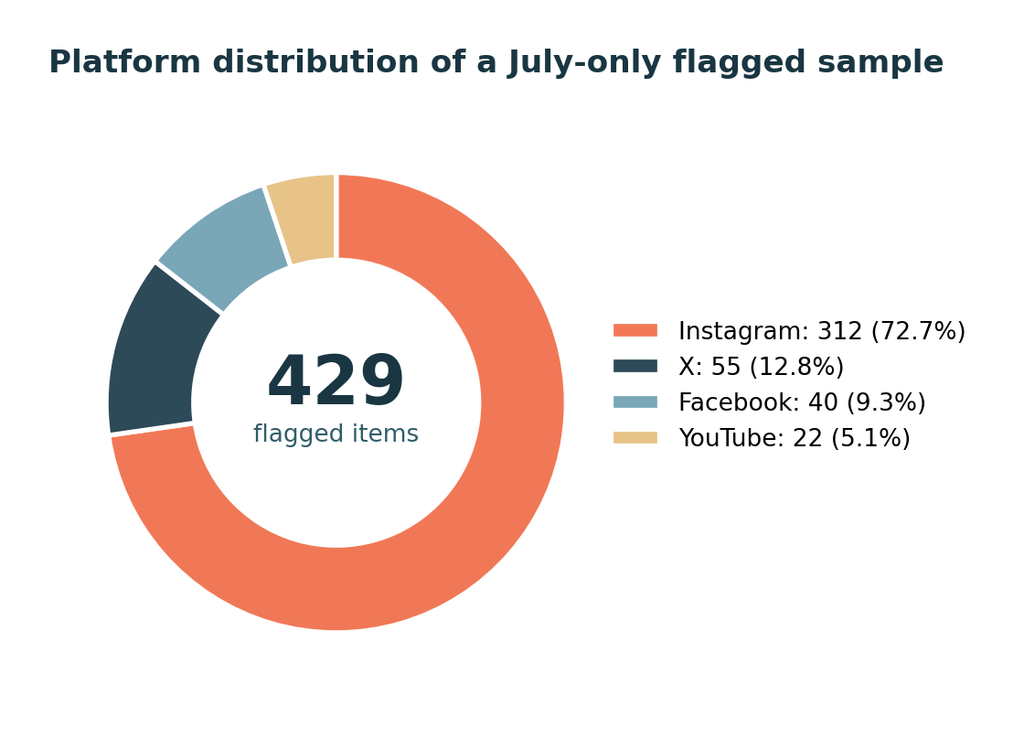
Source: Maharashtra Cyber sample, as reported by The Times of India
The issue did not end in July. The Economic Times reported Delhi Police’s clarification that an older Jantar Mantar crowd video was being presented as new October footage. India Today documented fabricated AI reporters and protest-related visuals in the later phase. These reports show that misinformation became a continuing feature of the coverage, but there is no verified May–October cumulative count in the supplied material.
In October, the cause changed while the protest identity remained
The next prominent CJP dispute concerned the Election Commission’s Special Intensive Revision of electoral rolls and demands involving Chief Election Commissioner Gyanesh Kumar. The allegations and political interpretations were contested. The Indian Express reported an October Bengaluru demonstration attended by creator Dhruv Rathee and others. The broader point is that the CJP name carried into a second issue cycle, bringing a familiar audience-discovery mechanism with it.
Ahrefs’ October figures are preliminary, and newer combinations of CJP and Gyanesh Kumar terms have limited established keyword history. It would be misleading to compare those very small estimated phrases with the complete July movement and conclude that October had little relevance. The stronger observation is the continuity of the protest’s recognisable identity.
So, was CJP an influencer-led protest?
CJP did not need every creator to agree with it to become influential. Supporters posted their interpretations; critics challenged them; journalists interviewed visible organisers; fact-checkers responded to altered material. The same story moved repeatedly between Instagram, YouTube, Google searches, television and the streets.
Influence can make an issue impossible to ignore. It cannot, on its own, establish who is right, who attended or why a government made a decision.
That is the most useful answer for a creator-economy publication. Creators clearly shaped the movement’s visibility and narratives, while students, organisers, police, journalists and political institutions also shaped what happened. The audience figures, search estimates and video coverage demonstrate attention and distribution, not unanimous support or direct causation.
Today’s India increasingly encounters public issues through people it follows. CJP shows both the opportunity in that change and the responsibility attached to it. For a new creator, the lesson is that influence can emerge outside traditional institutions. What matters is whether the information being shared deserves the trust that reaches it.
Data and methodology
Ahrefs: India historical monthly estimated search volume for specified phrases, May–October 2026. The six monthly estimates were summed only to describe modelled demand for those phrases; this is not Google’s exact logged searches or unique users. October is incomplete.
Qoruz/Instagram: figures are from account screenshots and TCI-provided engagement figures dated 13 October 2026 and may change.
Social reporting: sourced separately to named publications. Individual creator-role claims in the editorial brief remain subject to independent corroboration before publication.