
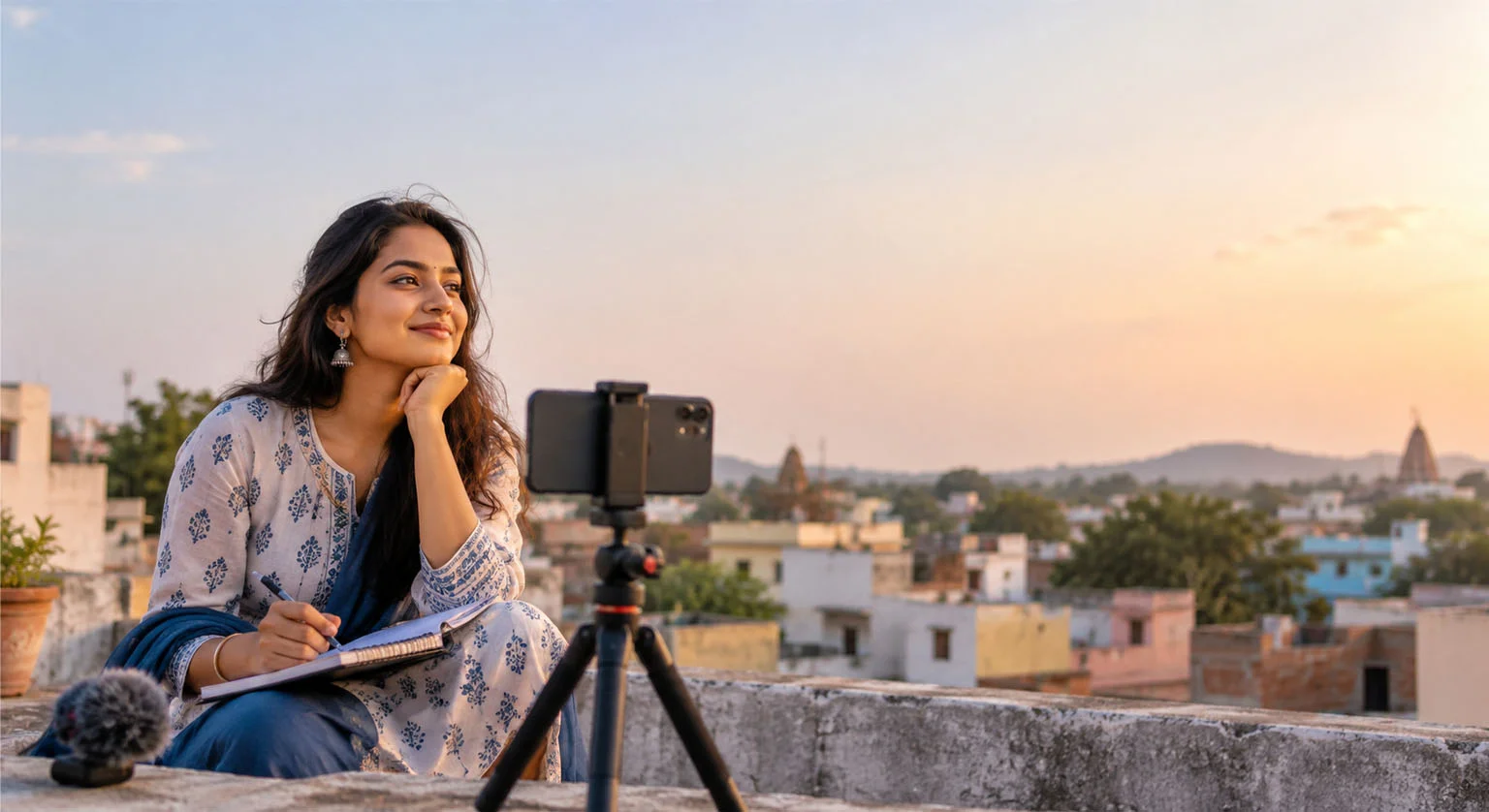
Yashoda Lodhi, who runs the Instagram page, ‘English with Dehati Madam’, has her videos travel much farther than she can.
An educator who creates content from Lodhankapurwa, a village in Uttar Pradesh’s Kaushambi district, she has built an audience of roughly 700,000 followers. Some of her videos have drawn millions of views. Yet the commercial opportunities that follow those numbers can be modest: she told TCI that offers range from ₹5,000 to ₹10,000, even when a brand expects polished production.
One collaboration paid her ₹25,000 for two videos. She said each took more than three hours to make, with noise and interruptions around railway crossings adding to the work. She also appeared on a prominent game show, but according to her, she still hasn’t been paid for that appearance more than six months after the telecast. This has dissuaded her from taking other opportunities because she fears she won’t be paid for her work.
The numbers point to a paradox at the centre of India’s creator economy. A creator can command an audience advertisers once struggled to reach and still struggle to turn that attention into reliable earnings.
India’s digital audience has already moved well beyond English-language and metropolitan markets. The Internet and Mobile Association of India (IAMAI) and Kantar’s Internet in India 2024 report estimated that 870 million internet users accessed content in Indic languages in 2024, representing 98% of internet users. In urban India, 57% of internet users said they preferred accessing internet content in Indic languages.
A 2026 study by the Indian School of Business and creator marketing platform HashFame suggests the challenge isn’t a shortage of creators, but a shortage of reliable commercial opportunities. The study found that non-metro creators accounted for 66 per cent of India’s 4.12 million creators in 2025, registered on influencer marketing platforms. Yet nearly 85 per cent out of the non-metro creators reportedly completed no paid brand campaigns that year
For creators outside the principal advertising centres, those questions are often shaped by practical constraints as much as by follower counts.
The cost of being elsewhere
Shahrukh Attar, a photographer, traveller and digital creator based near Khopoli in Maharashtra, has found that his location offers both an advantage and a limitation. The surrounding landscape gives him access to forts, nature, and destinations that can set his travel content apart. But brand meetings, networking events and shoots are often organised in Mumbai.


“A creator who lives outside the city may need to account for transport, accommodation and time away before deciding whether a collaboration is worth accepting. An offer that looks attractive on paper can become less profitable once those costs are deducted,” he told TCI.
Attar said that two creators with similar follower counts and reach could receive different offers. In his experience, regional creators may be offered barter arrangements or smaller budgets despite producing professional content and generating strong engagement.
He was careful not to attribute every missed opportunity to geography. But he said being outside an industry hub can make it harder to build the connections that bring work in the first place.
A campaign does not have to explicitly exclude a creator from a smaller town for its requirements to disadvantage them. A short-notice shoot, an in-person meeting, or a production schedule built around a metropolitan team can narrow the field before a brand has assessed the creator’s work.
Abhishek Pandey, a creator from near Gorakhpur in Uttar Pradesh, faced that problem when a Delhi-based brand asked him to attend a shoot the next day. He was in his village and could not make the journey in time. “The collaboration did not go ahead”, he said in a statement to TCI.
Pandey later moved to Delhi, where he gained greater exposure to brands and the content-creation business. His experience shows how access depends on proximity: a creator may have an audience and the ability to produce content but still miss an opportunity because they cannot reach a city fast enough.
For creators in smaller towns, the disadvantages can begin even earlier in the production process.
Pandey recalled struggling with internet connectivity in his village. At times, after shooting and editing a video, he had to leave the village and stand outside for an hour or two to upload it. The time spent securing a connection was time not spent making the next video.
Silrikchi Sangma, a creator based in Tura in Meghalaya’s West Garo Hills, has used social media to raise public awareness, promote government schemes, and share community messages. She told TCI that access to brand networks, professional resources, and collaborations remained more limited than in metropolitan cities.
Sangma did not claim to know precisely what metro-based creators were paid, making a direct comparison difficult. But she said collaborations could be paid or barter-based, and that creators in smaller states deserved compensation that reflected their reach and effort.
Her uncertainty is itself revealing. Without regular campaigns, access to industry networks, or reliable information about prevailing rates, creators may struggle to know what their work is worth or what to ask for.
When reach does not set the rate
The difference between an audience and income is especially visible in the production demands of brand work.
Lodhi creates content while continuing to teach. She has learnt much of the technical side herself through YouTube, including recording and editing. On her account, the challenge is not only securing a brand deal but also meeting the production standards brands expect from creators with access to studios and professional teams.
Her representative agency, Grid Media’s founder Risham Dogra, told TCI that brands request high-end, 4K-quality videos while offering budgets of around ₹10,000, without providing the equipment or crew needed to produce them. In effect, creators are expected to deliver metropolitan-standard production with whatever local resources are available.
Rate cards don’t always show the full cost. They may include hiring someone to film, travelling to a suitable location, buying equipment or spending hours editing footage. When the creator absorbs those costs, a fee that initially seems reasonable can leave little income.
Hluii Sailo, a fashion creator from Aizawl, Mizoram, said regional creators could earn as little as one-tenth of what metro-based creators earn for comparable work. She also described the difficulty of negotiating fees in a smaller market, where information on industry rates and production resources is harder to access.
In a report published by Exchange4Media in 2025, industry sources estimated that a regional creator with more than 300,000 followers could earn 30 to 40 per cent less than a metropolitan counterpart with similar reach.
The accounts do not establish a universal pay gap between regional and metropolitan creators. Rates can vary by category, audience, engagement, campaign requirements, exclusivity and the commercial value a creator delivers. But they raise a question that follower counts alone cannot answer: when two creators can reach similarly sized audiences, what determines the price a brand is willing to pay?
Language may be part of the answer. Pandey said he believed brands sometimes valued creators with a more familiar metropolitan accent over those whose content carried a regional linguistic identity. He also suggested that advertisers could undervalue regional audiences, even when those audiences might be more relevant to a product.
The question of who gets seen extends beyond campaign fees to the events where brands cultivate their public image. During Fenty Beauty’s India launch, fans of Sonali Vaghari, a beauty and fashion creator from Kolhapur known for Rihanna-inspired makeup looks, questioned why the brand’s founder, Rihanna, hadn’t invited her to the event. The omission sparked debate over whether regional creators get the same visibility as those based in metropolitan centres.
Vaghari told ETBrandEquity that beauty brands can associate metro cities with an aspirational image and a particular lifestyle.
Regional language, however, is not merely a production characteristic. It can be the reason an audience trusts a creator in the first place. A creator who understands local references, speech and habits may be better placed to communicate with a specific community than someone delivering a generic script.
The commercial question is whether brands recognise that value when negotiating fees, or treat regional reach as a cheaper substitute for a more metropolitan audience.
The network behind the numbers
Talent agencies can help creators negotiate contracts, find campaigns and understand the market. But representation often depends on discovery: whether an agency finds a creator, understands the audience, and decides the business is worth pursuing.
Pandey said he had not yet secured agency representation. He believed agencies could do more to discover talent outside the cities where the industry is concentrated.
Attar similarly argued that agencies should look beyond existing networks and actively scout creators in smaller cities. For someone without those connections, finding a brand contact or learning how to price a collaboration can take considerable effort before the work even begins.
Geography can also affect whether a creator is considered for a campaign at all. Ashtra Hmar, from Champhai in Mizoram who later moved to Delhi, said she lost a collaboration because of travel time and logistics. She believes brands can favour metropolitan creators even when regional creators have comparable follower counts and engagement.
Relocation may improve access to meetings, production teams and last-minute shoots. But it also comes at a cost, and it isn’t a realistic or necessary solution for every creator. For some, the location that makes commercial work harder is also what makes their content distinctive.
The industry’s challenge is therefore not simply to bring more creators to major cities. It is to make discovery, production and collaboration less dependent on where a creator lives.
That could mean giving creators clearer information about rates, budgeting production and travel separately, offering remote alternatives when an in-person shoot isn’t necessary, and assessing proposals on audience relevance and campaign performance rather than location alone. Agencies could also broaden their scouting beyond creators already visible in established networks.
An audience is not a business
For Lodhi, the distance between online attention and commercial security remains tangible. Her videos can reach millions, but she still has to work within a village’s constraints, limited production support, and offers that may not fully account for the labour involved.
India’s creator economy has become adept at measuring attention: views, followers, shares and engagement. Those figures can establish that an audience exists. They cannot show whether a creator is paid on time, whether the costs of making the content are covered, or whether the next collaboration will arrive.
For creators working outside the industry’s main centres, the distance between those two realities can be especially wide. The audience may already be there. The infrastructure that turns it into a livelihood is still catching up.