Meta’s latest EU disclosures show Instagram continuing to grow faster than Facebook, giving creators and brands another reason to review where their European audiences are active.
In the first half of 2026, Instagram recorded 297 million monthly active users in the European Union, compared with 264 million for Facebook. The figures came from Meta’s latest Digital Services Act (DSA) transparency reports, which cover user numbers and content moderation. Facebook usage has remained relatively flat, while Instagram has continued to rise.
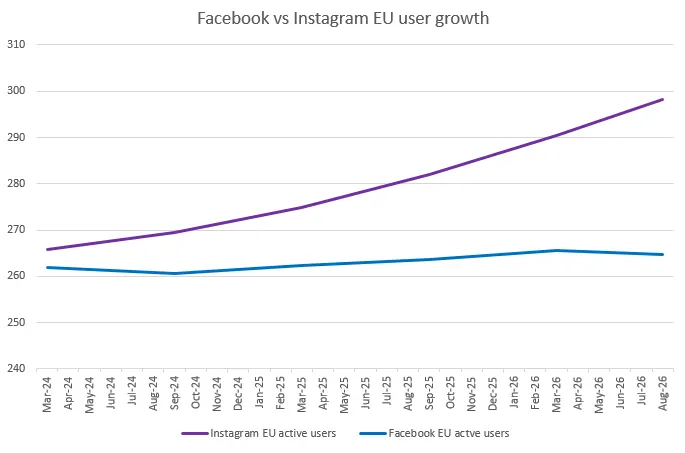
Instagram reached 297 million EU users
Under the DSA, very large online platforms must publish average monthly active user figures for the EU every six months. Meta‘s latest data put Instagram 33 million users ahead of Facebook. Instagram is approaching 300 million users in the region, while Facebook’s total has remained broadly flat and declined in some previous reporting periods.
Threads recorded 41 million EU users over the same period, far below Meta’s two larger social platforms. The numbers measure regional reach, not time spent, engagement quality or the commercial value of an audience, so they should not be read as a complete ranking of marketing performance.
What the figures mean for creators and brands
For creators targeting Europe, Instagram‘s growth could increase the potential audience for discovery and collaborations. The most useful signal remains a creator’s own audience data: where followers are based, which platform drives meaningful engagement and which formats convert viewers into subscribers, customers or community members.
For Indian creators, the figures matter mainly if they are building an audience in Europe or working on international campaigns. Meta’s filing does not contain India-specific data, so it cannot show whether the same shift is happening in India.
Brands should therefore avoid moving budgets on the strength of regional user totals alone. The figures are a prompt to compare Instagram and Facebook performance by placement, audience location, engagement and campaign objective. They may also place more weight on the geographic make-up of a creator’s audience during selection.
Meta also reduced its EU moderation workforce
The same report showed that Meta’s EU moderation workforce fell from about 7,700 people in March to about 5,900. The disclosure does not establish whether the reduction has changed content-safety outcomes. For advertisers, this is a separate issue from user growth and should be assessed through brand-safety controls and placement performance.