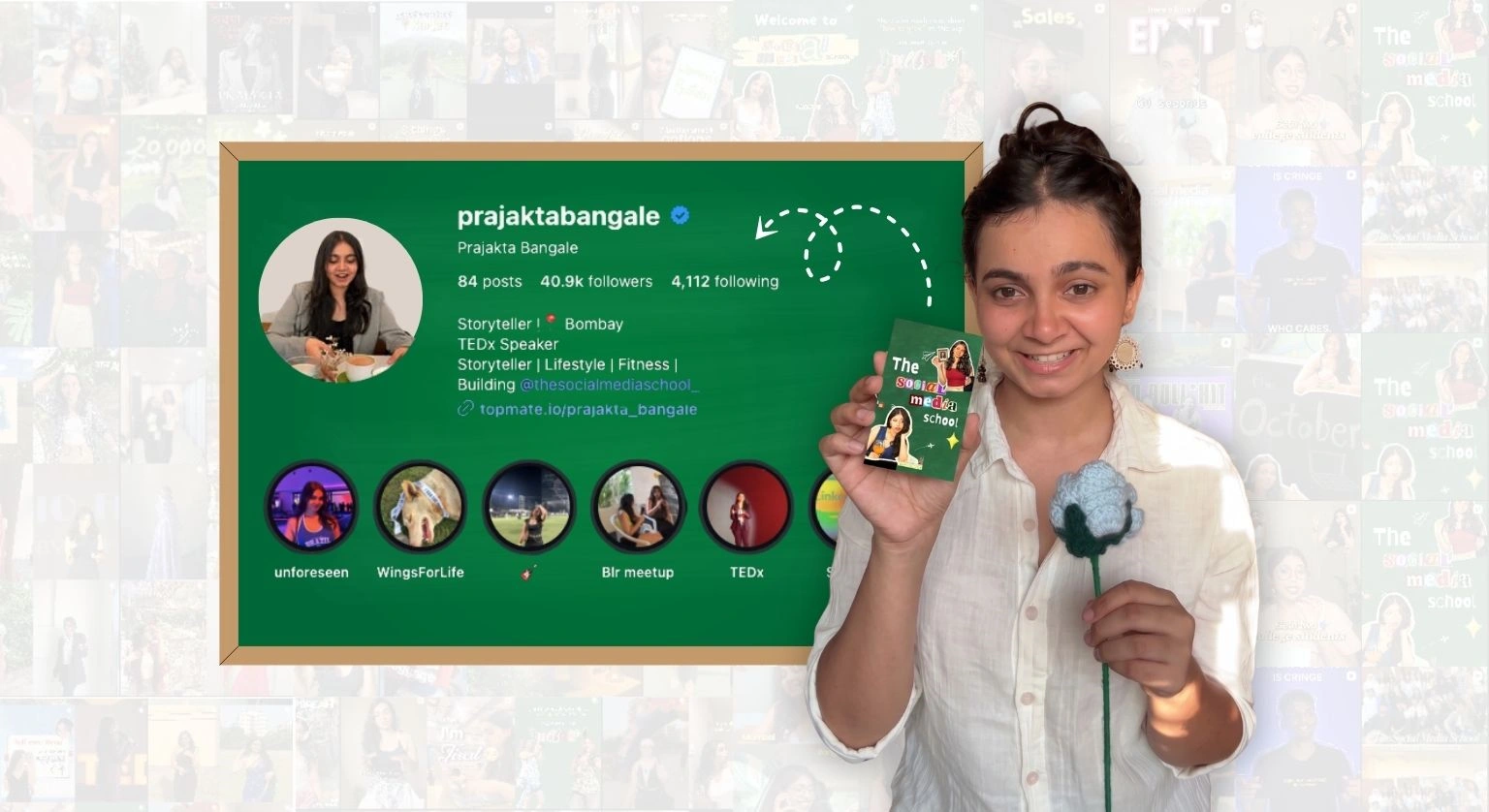
Prajakta Bangale is 21, in her final year of college, and has turned just 80 Instagram posts into 40,000 followers on the strength of one idea: post and forget, and let the story do the work.
- Can you give a quick introduction about yourself — how you started as a creator/business owner, and when it clicked for you to begin content creation?
- Why did it matter so much to have an iPhone specifically?
- Can you talk a bit about your business, the social media school?
- How many students have you trained so far?
- Most creators believe growth only comes from posting more content. You have just 80 posts and 40,000 followers, what do you think you did differently to achieve this?
- What is the biggest myth Gen Z believes about becoming a creator today?
- A lot of young creators think consistency is the hardest part. From your experience, what is actually harder than consistency?
- What is one opportunity you got because of your content that no amount of college education or a resume could ever have given you?
- If an 18-year-old creator walked up to you today and said “I want to be a content creator,” what’s the first thing you’d tell them not to do?
- If you had to start from zero today, what would your first 10 posts look like?
- Anything else you’d want to add for creators, for your audience, or for anyone who wants to start creating content?
Apart from a full-time content creator herself, she’s co-founded a social media school with a friend she met online, trained over a hundred students across two cohorts, spoken at TEDx at 20, and built a running list of brand deals, all without ever letting the number attached to a post decide whether it was worth making.
TCI spoke to Prajakta about building a creator business and a personal brand while still a student, at a moment when a growing number of Gen Z creators are treating content less like a side hobby and more like a career in progress.
What stands out across the conversation is how deliberately she’s thought through something most people her age are still figuring out by trial and error.
Can you give a quick introduction about yourself — how you started as a creator/business owner, and when it clicked for you to begin content creation?
I was always a creative child growing up, I wanted to become an actor or something creative. So in 11th grade I decided graphic designing was something I could learn and give it a shot. I did graphic designing professionally for a year after which I wasn’t getting clients so I pivoted to video editing. I did professional video editing for almost 1 to 1.5 years, and around then I worked with my first major client, a creator on LinkedIn who wanted to pivot to Instagram, and I helped edit her videos. For almost my entire first year I used my Android phone and edited everything on it, while constantly trying to grow my client base because I was saving up for an iPhone and I told myself the moment I got one, it was over for everyone.
Why did it matter so much to have an iPhone specifically?
For me it was mostly about content creation. The best sunlight and effects, the best clarity. Second, brands also need polished content.
Can you talk a bit about your business, the social media school?
I started this with my friend Monsoon Dave, who’s actually been my online friend. About six months later, after a lot of video calls, I decided I wanted to start something like this, because people are really confused when it comes to content but I felt we could build a solid roadmap and an executable process that actually helps people make better videos, make better content, and understand the psychology behind it. We had our first cohort back in 2025, October to December, and our second batch ran June to August, we just wrapped it up.
How many students have you trained so far?
In the first batch we had around 55 to 60 students. In this one we had 53. Every single person came only because of our personal brand and it was never about the course, it was ‘I want to learn from her.’ So ultimately it all comes down to your personal brand, and that’s one of the main reasons you need to connect with your audience, you can’t just make listicle videos and expect people to connect.



Most creators believe growth only comes from posting more content. You have just 80 posts and 40,000 followers, what do you think you did differently to achieve this?
Creators do feel the need to post more because the algorithm is unpredictable, you’re only shooting arrows in the air. But once you understand storytelling psychology, I’ve found that the most viral videos I’ve had are the ones where I’m genuinely just being authentic to my story. For example, there’s one video I have pinned. When I was in seventh grade, I wanted to become a YouTuber, but kids at school made fun of me. Then in my first year of college, I wanted to do it again, and I did. That’s the kind of story I’ve told. Storytelling plays a huge role in how you grow as a person and how you connect with people, and I feel that’s the only reason low volume and high results go together.
What is the biggest myth Gen Z believes about becoming a creator today?
That the market is saturated,if you look back even two years, you might not have felt like there were as many people creating content, but right now everyone is creating content, whether they’re hitting their goals or not. So one of the biggest myths is thinking, ‘if I start today, I’m already late.’ To that I’d add, it’s always your story, your personality, and your on-screen energy that actually transfers to people. So it’s never too late. Even if you start five years from today, it will never be late, that’s something I genuinely believe. There are so many consumers, and I feel every niche has some audience out there.
A lot of young creators think consistency is the hardest part. From your experience, what is actually harder than consistency?
Strategic execution. Being smarter means thinking strategically like these are the types of content I’ll make, this is how I’ll plan and shoot ahead of time. Nothing is random, everything is precisely planned. The right amount of execution takes you a long way, and so does understanding what’s working and what isn’t and whatever’s working, double down on it; whatever isn’t, cut it. Analysing your content is a very important part of it too.
What is one opportunity you got because of your content that no amount of college education or a resume could ever have given you?
TEDx. I’d honestly never have gotten it otherwise, though I had manifested TEDx since my first year of college. After that, being based in Mumbai, a lot of colleges started inviting me to take freelancing sessions. By third year, I’d spoken at KJ Somaiya, at SIES, and I’d even been invited to an IIT Bombay event. All of it came through content creation.
If an 18-year-old creator walked up to you today and said “I want to be a content creator,” what’s the first thing you’d tell them not to do?
Don’t care about views; don’t focus on the output; only focus on the input. Post and forget, that’s how I try to stay sane, even now. The views can get to you, and your whole purpose of creating becomes about the numbers, and you start measuring your worth by them. That shouldn’t happen.
If you had to start from zero today, what would your first 10 posts look like?
My first 10 posts would completely revolve around my identity, and all of them would be about finding my target audience. I’ll use myself as an example: I’m 21, a fourth-year CS student, a content creator, a video editor, I love art, and I live with my parents. Those are all the identity pieces you’re working with. So if I’m making a ‘day in my life’ video, I’ll always fold my identity into the hook like ‘here’s a day in my life as a 21-year-old CS student trying to stay fit and also attend college,’ or ‘here’s what I eat in a day as a 21-year-old CS student trying to hit a certain amount of protein and fibre.’ Everything should start with your identity.
Anything else you’d want to add for creators, for your audience, or for anyone who wants to start creating content?
One thing I’d genuinely love to add is you don’t see the bizarre opportunities you’ve never even thought of, that come through content creation. Monsoon always says you get asymmetrical returns when you create content and you never know where an opportunity will find you, or who’ll want to work with you because of it. And second, whenever you’re starting out, focus on your community. Don’t forget your audience, because they’re the only reason you’re there. Part of connecting with your community is having IRL events, that’s the closest way to actually meet your people.