


Rajat Kumar once spent about ₹40 lakh on Meta and Google ads in a single year as head of marketing at Decodr, a data-science upskilling venture, and came away convinced that no ad budget is ever enough.
- How did you go from running paid ads to building content IPs?
- What is a content IP, and why should a brand build one instead of paying influencers?
- Which is your best niche till date that worked and one that didn’t?
- Why did the Bhagavad Gita page outperform travel on reach?
- How did one travel reel turn into thousands of itinerary requests, and how did you make money from them?
- Walk us through a FramesNFlights reel. Who is involved, and how long does it take from idea to posting?
- Did followers know from the start that the couple was AI, and how did they react once it was disclosed?
- Glido Labs says AI cuts production costs by 70%. Compared with what?
- Where does AI still fall short, and when should a brand hire a human creator instead?
- Where do you see Glido Labs’ biggest opportunities over the next two years?
- What should human travel creators take from FramesNFlights, and where is influencer marketing headed?
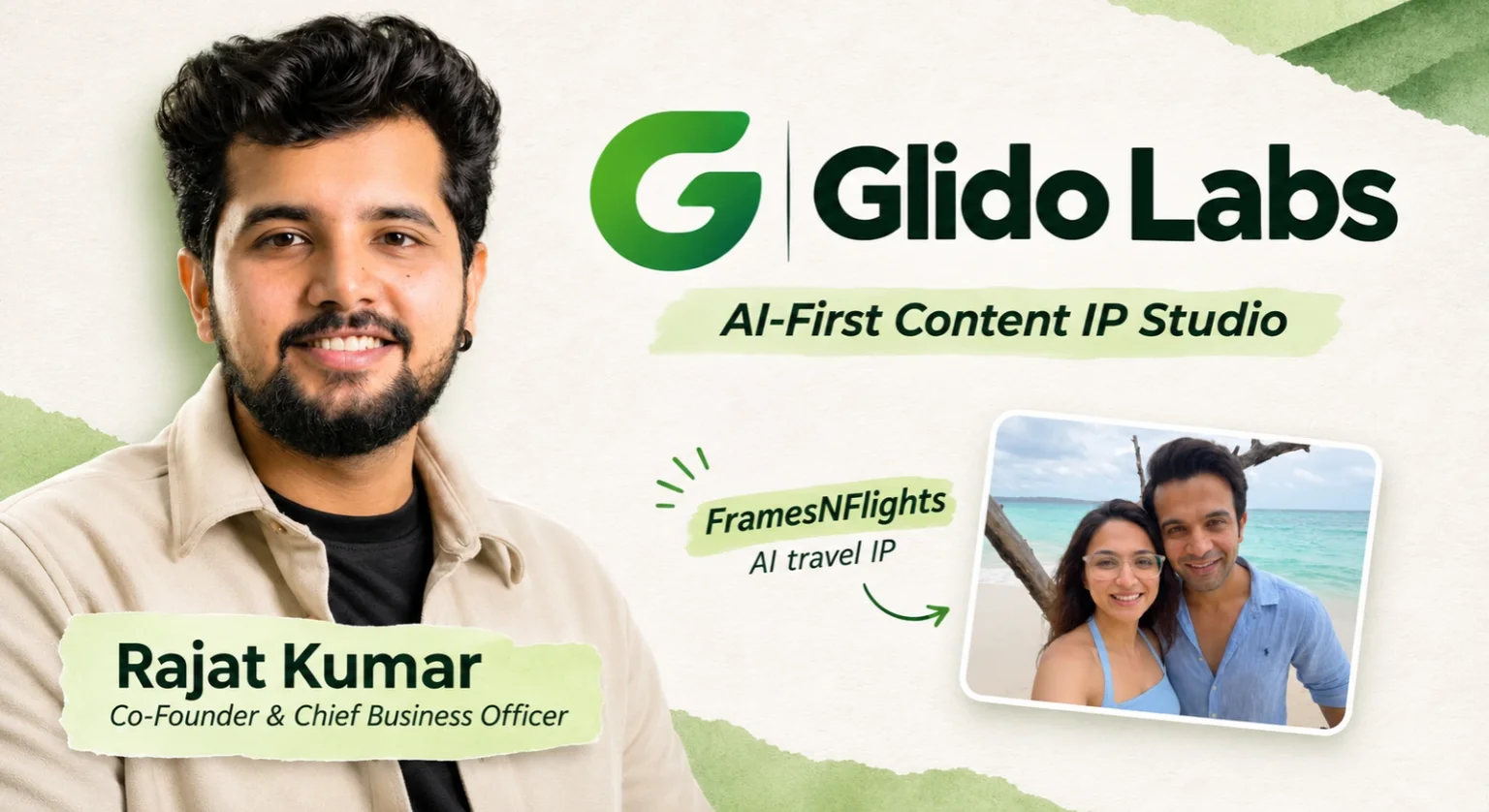
His answer is a travel couple who do not exist, in reality. FramesNFlights, an AI-generated couple run by Glido Labs, where Kumar is co-founder and chief business officer, posts reels on lesser-known destinations. One of them, on Jawai in Rajasthan, pitched as a cheaper alternative to Kenya’s Masai Mara, drew 9.8 million views and around 50,000 comments asking for the itinerary, according to Kumar. Every request gets an automated DM that leads to a landing page, and from there to a partner travel agency that pays Glido Labs a fixed fee plus commission on the bookings it closes.
Glido Labs calls these properties content IPs: repeatable formats that a brand owns outright, so the audience stays after the campaign money stops.
In his interview with TCI, Kumar breaks down how those itinerary requests were turned into revenue, how an AI commercial compares on cost with a ₹8 lakh to ₹10 lakh shoot, and where he still tells brands to hire a human creator.
How did you go from running paid ads to building content IPs?
I’ve been in marketing for eight years, and in that time I’ve tried almost everything, from organic content marketing to performance ads, webinar funnels and managing entire end-to-end funnels.
We first built Brand Samosa, a B2B marketing agency that helped brands generate leads, so I have about three years of experience in B2B marketing specifically. However, service businesses took a hit during COVID, and then people started spending heavily on upskilling. As head of marketing for Decodr, I ran Meta and Google ads and spent about ₹40 lakh on ads in a single year.
That’s when I realised that with paid ads, no matter how much budget you spend, it’s never enough. I needed a path to sustainable organic growth, so I left that setup and started creating content on my own profile. Coming from B2B, I experimented on my own profile first, got results, and then pitched those exact systems to clients.
As AI began advancing, my co-founder, Ravinder Singh, who had been working in AI for four years, and I combined forces: his technical background in AI with my background in storytelling and content. We realised brands badly need content IPs.

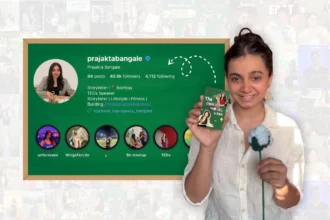
What is a content IP, and why should a brand build one instead of paying influencers?
A content IP is anything repeatable. IPL is India’s biggest content IP, and Bigg Boss and Roadies are content IPs too. Creators and brands are doing this now, like Samay Raina with India’s Got Latent, or even restaurant owners like Mokai in Mumbai. But full-fledged show IPs require massive production budgets.
When you hire traditional influencers, you pay them per post or per campaign, but you don’t own their audience. They do. The moment you stop paying them, the traffic stops. A content IP studio builds an owned content engine for your brand, with a dedicated community that looks directly to your company.
Owning a content IP also lowers your performance ad costs. People scroll past thousands of ads every day, and they stop at brands they already recognise. That familiarity makes every downstream ad campaign cheaper and more efficient.
Look at Traya. It consistently educates people on the causes of hair loss and the remedies without pushing its product every second, so when someone finally reaches the point of buying a treatment, they choose Traya, because Traya educated them and built that trust.
Which is your best niche till date that worked and one that didn’t?
We were testing several niches simultaneously: Bhagavad Gita, marketing and branding, career, astrology and travel. Our Bhagavad Gita page grew to 200,000 followers in a couple of months, but we realised that audience wasn’t easy to monetise. Then we launched our travel IP, FramesNFlights, which grew from zero to 35,000 followers in three months. That proved my first hypothesis, that people want repeatable, value-driven content IPs.
Astrology went crazy. It’s 100% automated, using an end-to-end workflow of AI agents. The agents research, write scripts, generate our custom AI influencer, edit the final video and publish it automatically. Astrology worked exceptionally well for selling digital products. We trained a model to generate custom Kundli predictions for ₹200 to ₹300, and whenever an astrology reel hit around 100,000 views, we’d convert 20 to 25 digital product sales.
Travel had a larger reach, even though selling a direct ₹200 digital product wasn’t as straightforward there. People were deeply engaged with the destinations we highlighted.
We’ve also shut down several channels. We tested one featuring a 45-year-old homemaker from a tier-2 city sharing advice on family, parenting and home management. The niche had immense long-term potential for home products, but building it needed significant bandwidth, so we paused it to focus on high-conversion niches that deliver immediate lead performance for client brands.
Why did the Bhagavad Gita page outperform travel on reach?
In India, these niches have the most organic reach: astrology, Bollywood, cricket and devotional. Devotional content addresses universal questions of identity and philosophy. Two people in completely different life situations can hear the exact same Gita quote and both find it deeply personal, and that yields massive viral reach.
But while devotional content gets massive impressions, travel delivers higher commercial intent, because travel audiences have disposable income and a direct intent to buy.
How did one travel reel turn into thousands of itinerary requests, and how did you make money from them?
We focused heavily on hidden gems. Everyone was posting about Masai Mara, so we highlighted Jawai in Rajasthan as an affordable Indian alternative. That single reel hit 9.8 million views and generated more than 50,000 comments asking for the itinerary link. It completely packed out the location. It proved that if your content solves a genuine customer problem, like discovering unique and affordable travel, you can plug your business backend into it to capture leads or conversions.
My second hypothesis was whether a content IP could directly drive revenue. In 90 days, our travel IP generated 45,000 itinerary requests, which came in as comments on our posts/reels. Using automated messaging workflows, we instantly sent each person a DM with tracked links to custom landing pages, where they could view the full itinerary.
To monetise that demand, we partnered with travel agencies on a fixed sponsorship plus commission model. We routed qualified leads to their booking engines and earned a fixed publishing fee alongside commission on bookings that converted. If I wanted to start a travel agency tomorrow, I’d already have a thriving pipeline built purely on organic content.
Walk us through a FramesNFlights reel. Who is involved, and how long does it take from idea to posting?
We have a content IP manager, who oversees our travel channels in English-Hindi and Tamil, and a scriptwriter. A reel goes through four stages:
- Research and ideation: the team researches hidden gems, like Jawai.
- Scripting: the content IP manager drafts a structured script built around strong hooks.
- AI production: the script moves to our AI production team, who maintain the digital assets for our AI travel couple and generate all the raw video clips from the script.
- Editing and publishing: the clips are edited, formatted and published.
The entire process takes a single day.
Did followers know from the start that the couple was AI, and how did they react once it was disclosed?
Early on, Meta didn’t require explicit AI labels, so it wasn’t highlighted. When Meta updated its policies, we turned on the AI disclosure tags. We worried that engagement would drop or that people wouldn’t take the content seriously, but the opposite happened. Viewers don’t care whether a creator is AI or human, as long as the content delivers genuine value, utility and insight. Instagram’s reach policies haven’t hurt our accounts either.
AI creators only cause backlash when they fabricate personal experiences or emotional stories, because that breaks the audience’s trust. As long as you stay transparent and focus on educational value, audiences embrace it. Under ASCI’s guidelines, we apply AI labels, and we refuse brand deals that ask our AI avatars to give fake personal product reviews. An AI persona giving a fake personal review damages the brand’s credibility more than ours. We only accept collaborations built on objective feature overviews and educational information.
Glido Labs says AI cuts production costs by 70%. Compared with what?
The 70% claim compares AI production with traditional commercial shoots. A traditional shoot means hiring production crews, directors, actors, lighting teams, sound engineers and locations, and it easily costs ₹8 lakh to ₹10 lakh per video commercial. An equivalent high-complexity AI commercial costs around ₹2 lakh to ₹3 lakh. Our team has spent two years mastering prompt engineering and model selection, which brings our generation costs down significantly.
Where does AI still fall short, and when should a brand hire a human creator instead?
Physical D2C products are a challenge at large volumes. When we produce 50 to 100 creatives in a batch, minor rendering variations can show up on product packaging. With smaller batches of 12 to 15 videos, our team can customise and check every product detail manually. So it’s manageable, but scaling creatives for physical D2C products on AI automation is still a technical issue.
Lifestyle brands still prefer human creators, because lifestyle relies heavily on physical product experiences and personal touchpoints. If a brand wants personality-driven mass awareness, human influencer marketing is the right choice. That’s why we focus on educational infotainment, which relies on delivering information rather than on a creator’s personal lifestyle. If a brand wants to reach consumers at the moment they’re deciding what to buy, like picking one specific product at the supermarket, educational content IPs are far more effective.
Where do you see Glido Labs’ biggest opportunities over the next two years?
First, astrology content is massive. We partner with an astrology brand to generate its AI video ad creatives at scale, and deliver around 20 AI video ads to them every day. Second, we’re productising our internal software. The AI tool we built to generate ad creatives at scale for the same company is being polished, and we plan to launch it as a public SaaS tool within the next one to two months.
What should human travel creators take from FramesNFlights, and where is influencer marketing headed?
The biggest takeaway is that content performance comes from scripting, hooks and research. AI is merely our production layer. Human creators should focus heavily on research and on conveying extreme emotions, such as joy, shock and sadness, which algorithms prioritise.
In five years, brands will own their content IPs. Human creators will move into conceptualising scripted micro-drama series and pitching them to brands, the way JK Super Cement funded a micro-drama about a young couple building their dream home.