
YouTube looks healthier than ever from the outside. Videos are reaching more people, Shorts are exploding, and Alphabet just posted another blockbuster quarter. But talk to individual creators, and you’ll hear a different story: fewer seconds watched, fewer ads shown, and shrinking payouts per video.
A new year-over-year study from marketing platform Metricool, which analysed nearly 800,000 videos across more than 71,000 accounts, puts hard numbers behind that gap. Comparing February 2025 to February 2026, it found a platform where reach and revenue are pulling in opposite directions.
More Views, Less Attention
Long-form videos are getting far more eyeballs than a year ago, and Shorts are growing even faster. That part of the story is good news for anyone trying to get discovered on YouTube.
The catch is what happens after someone clicks play. Viewers are leaving much sooner than they used to, on both long-form videos and Shorts. Engagement, meaning likes, comments, and shares, is also slipping on both formats.
Here’s why this matters more than the raw growth numbers: YouTube’s algorithm and its ad system both reward watch time, not just views. A video that gets clicked a lot but abandoned quickly signals to YouTube that it isn’t holding attention, which can hurt future reach. It also means fewer opportunities for an ad to actually finish playing, which is where the real financial damage happens.
Why Ad Revenue Is Falling Even Though Views Are Rising
This is the part creators feel directly. Ad impressions and monetised playbacks on long-form video both dropped sharply, and estimated ad revenue and YouTube Premium revenue fell along with them.
Metricool’s explanation is straightforward once you think about how YouTube ads actually work. A mid-roll ad only plays if a viewer sticks around long enough to reach it. If the average viewer is bailing out around the two-and-a-half-minute mark instead of watching closer to four minutes, a huge share of ad slots simply never get triggered. More views without more watch time means more missed ad opportunities, not more income.
In short: creators are being judged by a vanity metric, views, while getting paid on a completely different metric, watch time. When those two move apart, the paycheck suffers even as the growth chart looks great.


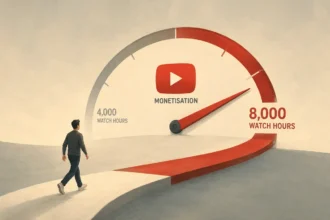
Small Channels Are the Only Ones Getting It Right
Growing into a bigger subscriber tier is still rare for most channels overall. Small accounts had the best shot at levelling up, followed by tiny accounts.
Micro accounts had a strange, almost cautionary story: their long-form views grew the most of any tier, but their watch time and engagement fell the hardest of any tier too. That’s a classic case of reach without retention, exactly the pattern dragging down the platform average.
Small accounts, in the 2,000-to-10,000 subscriber range, were the one group that grew on both sides at once. Their view duration and engagement both went up rather than down. That combination is worth paying attention to if you run a channel in that range, since it suggests their audience isn’t just clicking; they’re actually staying and interacting, which is the exact behaviour that protects ad revenue.
So Why Does YouTube Itself Look Fine?
This is the part that confuses people, and it’s worth explaining clearly instead of just stating the number. YouTube’s overall ad business posted double-digit growth in the most recent quarter, and the platform has crossed $60 billion in annual revenue.
That’s not a contradiction of Metricool’s findings, it’s a mix shift. Platform-wide revenue can still climb even while the average creator earns less per video, if the growth is concentrated in a format that pays less to begin with. Shorts, for instance, carry far lower ad rates than long-form mid-roll placements, but they’re where most of the new viewing volume is going.
So YouTube as a company can look stronger than ever in its earnings report, while the typical creator experiences the opposite trend in their own analytics dashboard. Both things are true at the same time, they’re just measuring different layers of the same platform.
The Takeaway for Creators
The lesson from this data isn’t “make more videos” or “chase more views.” It’s the opposite: retention is now the metric that decides whether growth translates into income. A video that pulls big view numbers but loses viewers in the first 30 seconds is, financially, worth less than a smaller video that people actually finish. Anyone building a channel right now would do better focusing on hooks, pacing, and mid-video retention than on raw reach.